
Beneath the stars at Lynton Downs

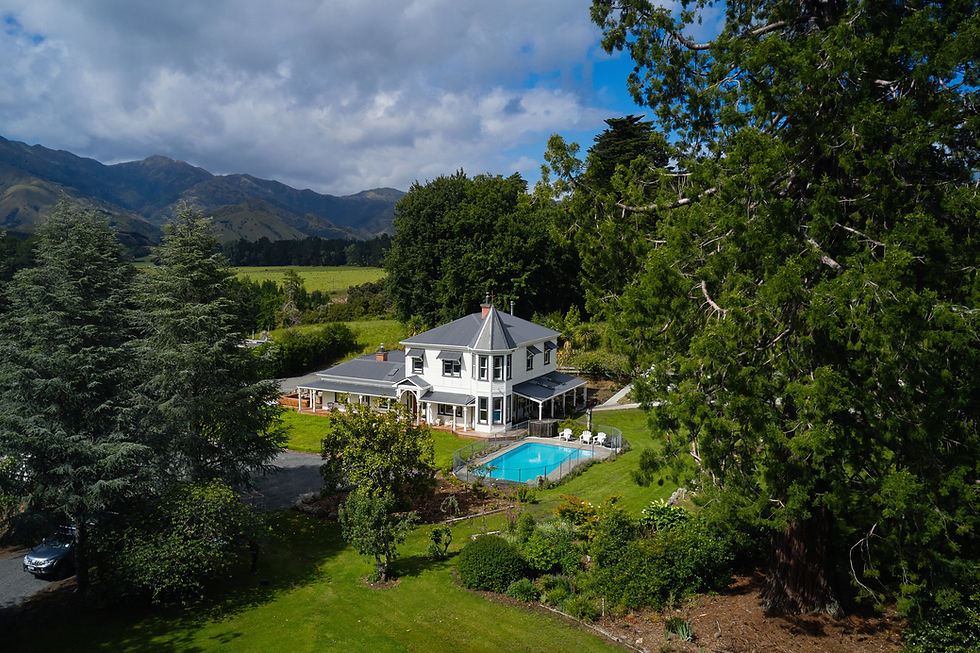
There is a quiet kind of magic about Lynton Downs.
Maybe it is the stillness of the hills. The creak of an old homestead staircase. The sight of sheep moving through the paddocks beneath mountain ranges that seem to rise straight out of the earth.
Or perhaps it is the feeling that this is a place layered with stories.
Built in the 1860s and added onto over generations, Lynton Downs has stood watch over inland Kaikōura for well over a century. The weatherboard homestead, complete with its distinctive turret and sprawling gardens, has weathered changing owners, farming seasons, earthquakes and family life.
Today, Lynton Downs remains owned by the Rickman family, who purchased the station in 1958. Rachel and Kurt Bartrum have spent the past 17 years farming the property and acting as custodians of its historic homestead, while quietly building a farmstay experience grounded in both luxury and authenticity.
The 3,500-hectare property runs Romney sheep, Angus cattle and forestry across the rugged inland Kaikōura landscape.
“We feel incredibly privileged to be part of this property’s history and preserving it for the future,” Rachel said.
“Lynton Downs is a very special place for a lot of people.”
The couple began the farmstay in 2014 after Rachel, who has a kindergarten teaching background, began looking for something she could do from home while still supporting Kurt and family life on the farm.
At the time, the East Wing of the homestead was sitting largely unused except for occasional visits from the Rickman family, while The Quarters, once home to shepherds and musterers, had become little more than a storage space.
“We cleaned out years of stored antiques, junk and even bees living in the walls,” Rachel laughed.
From there, the farmstay gradually grew into what is now a sought-after rural retreat attracting both international and domestic visitors.

Today, guests can stay either in the historic East Wing apartment within the original homestead or The Quarters, a restored cottage-style space overlooking the surrounding farmland and hills.
Many arrive from Europe through tourism operators specialising in smaller, experience-led accommodation away from busy tourist centres.
Others simply stumble across it while looking for something slower and more grounded than the typical holiday stay.
And that slower pace is exactly what many guests seem to remember.
“We’ll have guests from places like Singapore where they’re raising children in apartments overlooking concrete buildings,” Rachel said.
“Then they come here and their kids are feeding pet lambs, collecting eggs and picking apples from trees.
“You realise how special things are that you probably take for granted.”

Unlike heavily curated tourism experiences, the Bartrums have deliberately kept the farmstay connected to the reality of daily farming life.
Guests might watch working dogs move stock, wander down to the woolshed, walk through native bush gullies alive with birdsong, or simply sit quietly beneath the trees with a cup of tea.
“We don’t do a staged show-farm experience,” Rachel said.
“We just share what’s naturally happening on the farm at the time.”
That openness extends to the food baskets left in the accommodation too, often stocked with preserved fruit from the property, home baking and seasonal produce from the garden Rachel lovingly maintains herself.
“The garden is probably my therapy really,” she said.
“When we arrived, it hadn’t been loved for a long time, and after the earthquake we had to redo large parts of it again.”

The 2016 Kaikōura earthquake left significant damage throughout the property and homestead. At one point the family became trapped upstairs and had to escape through a bedroom window into the garden below.
“We’d actually practised what to do with the kids,” Rachel said.
“So, they kind of knew the plan.”
Large sections of the home were eventually stripped and rebuilt, though great care was taken to preserve the original character and footprint of the house.
Today, alongside the farmstay itself, the Bartrums are continuing to evolve the experience through environmental restoration projects, native planting and a new partnership with Moana Skies.
The collaboration allows guests to experience Kaikōura’s internationally recognised dark skies from the farm itself.
“We’ve got a site up on the property with virtually no light pollution at all,” Rachel said.
“The skies up here are pretty incredible.”
The couple have also fenced waterways, expanded native planting and are developing additional walking tracks through regenerating bush areas on the property.
For Rachel, however, perhaps the most rewarding part has simply been seeing people reconnect with a version of rural New Zealand that feels increasingly rare.
“We get busy doing the farming side of things,” she said.
“So, it’s actually really nice seeing people slow down and truly take it all in.”


Comments