
Built to last

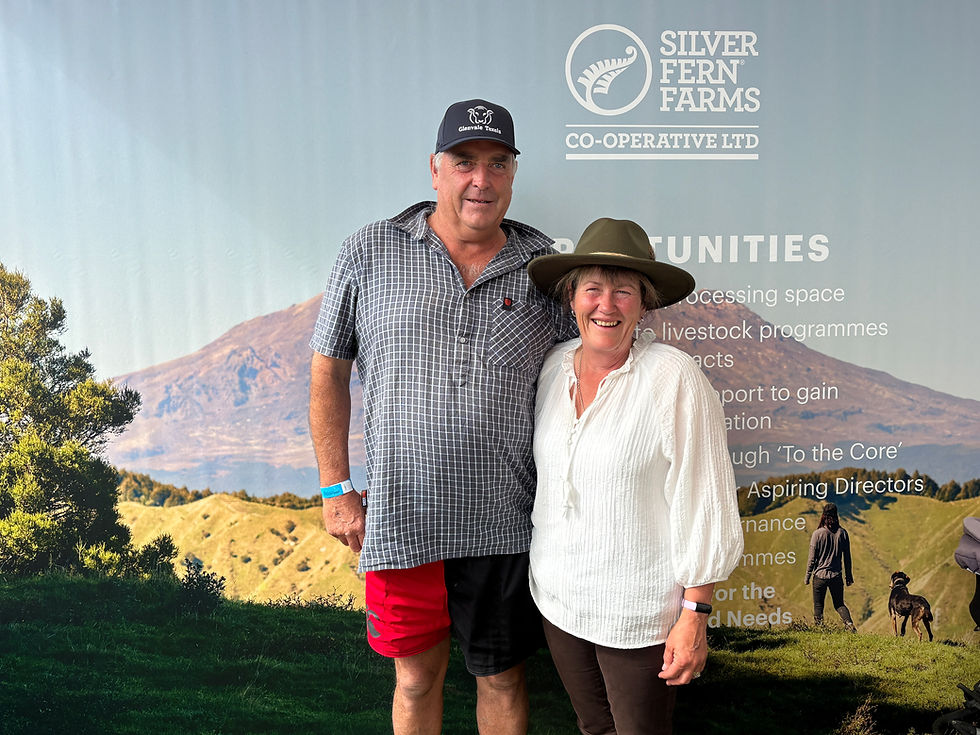
On a clear Southland day, with Stewart Island visible off the back of the property, Nathan and Joy Dodd’s Glenham farm does what it has always done - just gets on with it.
There is no big pitch, no grand claims. Just stock that performs, year in, year out.
The Dodds run Glenvale Texel Stud with their son Ted on around 600 hectares of rolling hill country near Wyndham, alongside a self-contained sheep and beef operation. Texels have been part of the farm since the early 1990s, introduced by Nathan’s father when the breed was still relatively new to New Zealand.
“It was more my father that got into them to start off,” Nathan says.
What started as a handful of sheep has been built steadily over time into a stud of around 300 Texels, supplying both stud and commercial farmers.
The reason they stuck with the breed is equally straightforward.
“Probably just a good, good meaty sheep,” Joy says.
“And good maternal as well. Good breeders, good mums.”
That balance - meat and functionality - still underpins the Glenvale approach today.
While Texels have become more widely used across the industry, often crossed into other breeds, the Dodds still see strong demand for straight Texel genetics.
“Most breeds have got a bit of Texel in them anyway now,” Nathan says. “But we’re still getting people coming to us for just a straight Texel.”
Their focus has never shifted far from the basics. Structure, constitution and meat yield come first, backed by performance data but not driven by it.
“We pick on structure and meat first,” Nathan says. “They’ve got to have a good meaty arse on them.”

Fertility has also been a key driver in their breeding programme. Earlier Texels were often criticised for lower fertility, something the Dodds have worked hard to change.
“Some Texels still have low fertility,” Joy says. “But we’ve just gone for fertility and meat yield.”
That approach is reflected in lambing results, sitting around 170 percent, with low losses.
“We don’t have a lot of death in them either, which is very good,” Joy says. “They hit the ground running.”
The sheep are expected to perform under real conditions, not just look the part.
“They’ll do good anywhere,” Nathan says. “They go on crops in winter and they just chug along on the swedes.”
The property itself offers little shelter in places, with stock exposed to full southern weather – including recent winds that caused widespread damage across the property.
“You look straight up to Stewart Island,” he says. “They get all the weather, but they just do well.”
That practicality carries through to how the Dodds sell their rams.
Rather than relying heavily on auction systems, most are sold directly off-farm - a model that has worked for decades.
“It’s probably more fair for the farmers that have been coming for years,” Joy says. “They’re still getting first pick.”
It is a more time-consuming approach, stretching across weeks of on-farm visits, but it builds long-term relationships with clients who return season after season.
Still, the stud holds its own in the sale ring. Earlier this year, a Glenvale ram made $5,600 at the Gore ram sale.
“Everyone’s looking for new bloodlines,” Joy says. “But it’s getting harder to find them.”
Finding those genetics is one of the ongoing challenges.
“It’s hard to find good rams,” Nathan says. “We go looking for constitution and meat… they’ve got to be right.”
The wider farm supports the stud with a straightforward, well-run system. The Dodds finish Hereford-Friesian cattle, grow all their own feed, and have recently shifted toward more precision cropping methods.
This season, swedes were precision-drilled for the first time.
“They’re a massive crop,” Nathan says. “We’ve always been a bit old school, but this has been unreal.”
Like many farmers, they are also navigating rising costs and uncertainty, particularly around fuel supply.
“We can’t get diesel at the moment,I’m on the list waiting.”

Nathan says they’ve had to fall back on smaller tanks and local supply where possible.
“We’ve got 200-litre tanks… you just shoot down to Wyndham and fill them up,” he says.
Contractors have already signalled price increases, and theft is beginning to re-emerge as an issue locally.
“People have started stealing it down here,” Joy says.
Despite the pressures, there is still a sense of quiet optimism - helped by stronger red meat prices and a modest lift in wool returns.
“There’s actually a bit of positivity out there,” Joy says. “Ours was up a good dollar a kilo this year.”
The farm itself has been built over generations, growing from around 150 hectares under Nathan’s father to its current size. Today, that legacy is continuing, with their son Ted now involved in the business as a shareholder.
“You can’t make your kids get involved,” Joy says. “But he’s always been interested in stock and machinery, he just enjoys it.”
Ted works off-farm for part of the year at Caldwell Contracting, returning home for key periods including lambing, keeping him connected while building his own experience.
For the Dodds, the rewards are not complicated.
“Just seeing our stock doing so well,” Joy says. “Even just the commercials. We’re proud of what we produce.”
Nathan pauses, then adds it more simply.
“They’ve just got to work,” he says.
It’s a simple measure of success. But on a Southland farm, in a business built over decades, it’s one that still counts.


Comments