
Doing it right, and doing it well

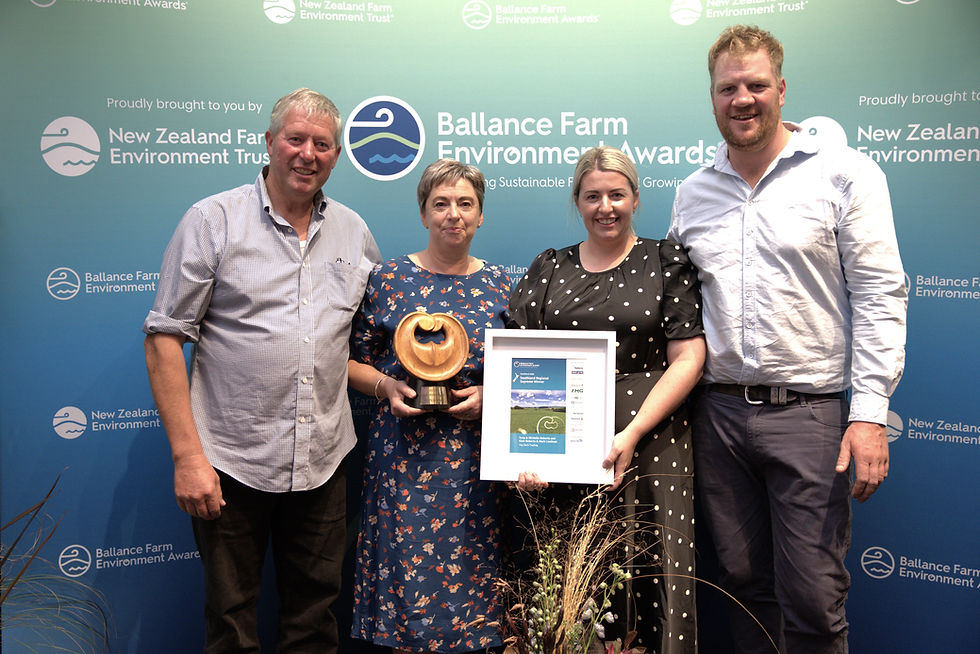
Tony and Michelle Roberts, alongside daughter Kate and her partner Mark Lieshout, run their Merino Downs farm near Gore as Top Deck Trading, a family operation built on long term thinking, hard decisions and a willingness to adapt.
This year, that approach saw them named 2026 Southland Regional Supreme Winners at the Ballance Farm Environment Awards.
“It’s probably an accumulation of a number of years being involved in the environmental space,” Tony Roberts says. “We’re just trying to do the right thing.”
That mindset sits at the centre of the Roberts’ 269-hectare operation, a system that has shifted significantly over the past decade.
After nearly 30 years in dairy, the family made the call in 2017 to step away.
“The big driver was really just time,” Tony says. “Being tied to milking twice a day, seven days a week, we just wanted a bit more freedom.”
They sold the dairy farm and started again, purchasing two neighbouring properties and building what is now a dual system operation, deer on one side, dairy grazing and beef on the other.
It has not been a straight line.
“We came into it with an open mind… we’ve made mistakes along the way, but we’ve learned a lot.”
Today, the farm runs around 650 red deer focused on velvet production, alongside a similar number of fallow deer supplying the trophy market, plus dairy grazing and a small amount of beef finishing.
What stood out to judges was not just production, but how tightly everything is thought through.
From infrastructure and stock systems to succession planning, the Roberts’ operation reflects a high level of detail and intent.

Underpinning it all is a strong environmental focus, something Tony says has been built over time, not bolted on.
A key piece of that is the farm’s wetland development, first shaped through their collaboration with Environment Southland and the Southland Environmental Advance Party (SEAP), a deer farmer led group focused on environmental solutions, and now expanded across the property.
“We wanted to capture the runoff and make sure the water leaving the farm was better than when it came in,” he says.
That work now stretches across more than seven kilometres of waterways, much of it fenced, with sediment ponds, plantings and biodiversity corridors linking areas of the farm.
“It’s not just about water quality, it’s about creating something that works as a whole system.”
It has not come cheaply.
“Fencing alone, when you’re talking $30 a metre for deer fencing, it adds up pretty quickly,” Tony says.
But like much of what they have done, it has been a long term approach.
That same thinking has carried through into wintering systems, with the Roberts early adopters of indoor wintering barns for deer, reducing pressure on soils through Southland’s wet winters.
Alongside that, they have taken a strong data driven approach to farming, something carried over from their dairy days.
“We’ve always been about gathering information,” Tony says.
Technology now plays a growing role across the business, from weighing and genetics through to monitoring water use and farm performance.
“It’s all very well collecting the data, but it’s what you do with it that matters.”
Looking ahead, he sees tools like AI helping farmers turn that information into better decisions.
“That’s the exciting part, how we actually use it.”
The wider deer sector is in a relatively positive space, he says, although softer velvet prices in recent seasons have taken some of the shine off.
“Apart from that, things are pretty good. We believe we’ve got the best velvet in the world, it’s just making sure the returns reflect that.”
For all the systems, investment and change, the Roberts are quick to come back to the bigger picture.

“We’re just trying to do the right thing, for the farm, the stock and the next generation,” Tony says.
“If we get it right at this end, it makes it a lot easier at the other end.
“We’ve only got this land once in our lifetime, and we’re only here for a short time, so why wouldn’t you look after it? It’s too precious not to.”
This is still a family farm, and a future focused one.
Kate and Mark are already embedded in the business, working towards future ownership, something the judges also recognised as a strength.
“It’s our life, our home and our business. We love being here.”
Winning the regional title has brought attention, something farmers do not always seek out.
“We don’t always tell our story very well,” Tony admits. “There’s a lot of good work going on out there.”
Sometimes, he says, you just have to put your hand up.
“If we want people to understand what we do, we’ve actually got to show them.”
Other Southland winners recognised
Alongside the Roberts family, a number of other Southland farmers were recognised across the awards.
Ivan, Denise and Kelly-Anne Hopper – Dairy Patch - Woodlands
Ballance Agri-Nutrients Soil Management Award
DairyNZ Sustainability and Stewardship Award
Tom, Denise and James Anderson – Awatere Station - Waikaia
Norwood Farming Efficiency Award
Bayleys People in Primary Sector Award
Rabobank Agri-Business Management Award
Mark & Elspeth Thomson – Lora Glen – Lora Gorge
Ministry for the Environment Biodiversity Award
Environment Southland Water Quality and Biodiversity Award
The Waikawa Catchment Group was also showcased for its long running, community led approach to improving environmental outcomes across the region.

Comments