
Fernbank: five years to a label


Some dreams sit quietly in the background for years.
Not because they are small, but because they require time, money, patience, and a certain amount of stubborn belief.
For Matt and Helen Barbour, owning their own vineyard was one of those dreams.
Matt has been in the wine industry most of his adult life.
He studied viticulture and oenology at Lincoln University in the mid-2000s and has worked in wine since.
Having a vineyard was never guaranteed, but it was always the goal.
“I wouldn’t say having a vineyard was inevitable, but it’s always a dream, I guess,” he says. “Like that’s sort of what you want to do, own your own vineyard and maybe have your own label.”
In 2020, the opportunity finally came up. They had been looking around the Waipara Valley for a site that could become more than a job.
What they found was a limestone hillside that Matt admits he never expected they would be able to buy.
“Purely and simply just because of its location,” he says. “For Pinot Noir and Chardonnay the soils up here are pretty much perfect. Limestone laced.”
That site is now Fernbank Wines. A dream built on a very specific patch of North Canterbury ground.

Finding Fernbank
Fernbank spans 8.3 hectares. Around 5.5 hectares are planted in Pinot Noir, two hectares in Chardonnay, and a smaller block in Viognier.
The name itself came from the place.
“When you search our location for the weather it says Fernbank,” Helen says. “And I was like, oh… it’s more than just a name.”
Neighbours later confirmed the hills were historically known as Fernbank before the land was subdivided. The property also carries pieces of older history.
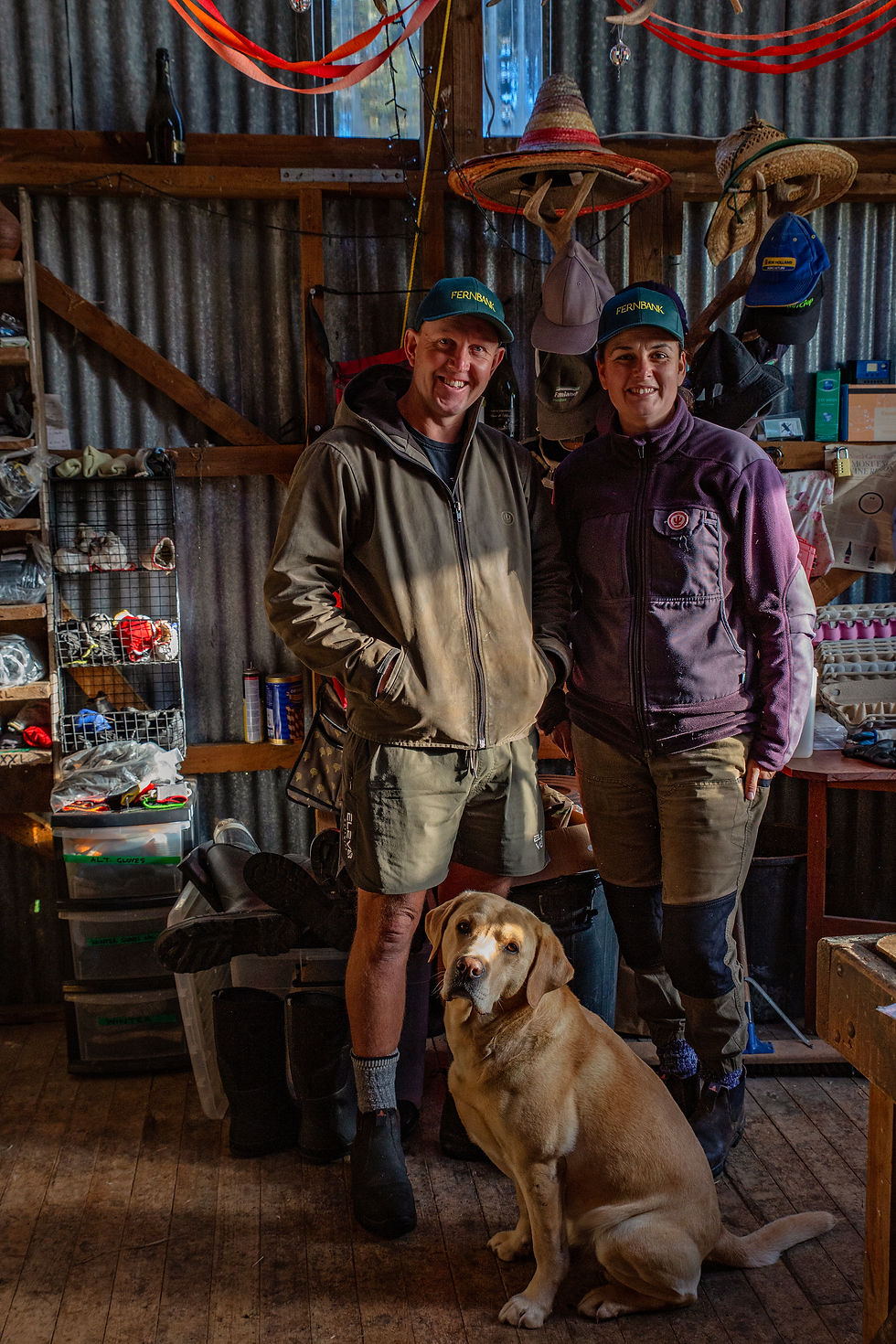
A wool shed on the vineyard dates back to 1914, built by the Harris family and finished just before one of the farmers left for war.
“Fernbank” is stamped on its door.
“They basically built it and finished it before going away,” Matt says. “We’ve got a photo of them sitting on the steps in front of it. And then he went away to war and he never came home.”
When the Barbours took over, the shed was filled with old vineyard gear.
They cleared it out and turned it into a working space. It is not fancy. It does not need to be – but with a chandelier made of antlers found by Matt on a nearby vineyard, and a taxidermy stag affectionately known as Stan on the wall – it has a quirky rustic charm.
It reflects what Fernbank is right now: a vineyard being built slowly and deliberately.

From yachts to vines
Helen’s path into wine has been anything but conventional.
Originally from England, she met Matt while the two were working on private yachts in Florida. They spent two and a half years working together on the same boat, living in the same small cabin.
That was where the vineyard dream first came up.
When they eventually moved to New Zealand, Helen worked in public health. Her role later shifted into alcohol licensing, and during COVID she found herself in the middle of the public health response.
The contrast between that work and time spent in the vineyard became stark.
“Two days here it was like coming up for air and therapy,” she says. “Just like, this is wonderful.”
Eventually she decided to make the leap.
She took a job at Pegasus Bay for a season, learning quickly under experienced vineyard staff.
The learning curve was steep, and it helped shape how Fernbank operates today.

Building it the hard way
For the first few years the Barbours were juggling full-time jobs alongside the vineyard. Evenings and weekends were spent pruning, spraying, tying vines and trying to keep up with the season.
Eventually something had to give.
Today they still run the vineyard largely themselves as a mostly full-time gig.
When asked how many staff they employ, Matt answers simply.
“None.”
Contractors help with harvesting at times. Family members pitch in when they visit. They also host WWOOFers through the warmer months.
From October through April, travellers stay with them and exchange a few hours of help in the vineyard each day for food and accommodation. Along the way, the Barbours share what goes into running an organic vineyard and the realities of growing wine.
“It’s not necessarily hard work,” Helen says. “It just needs someone to go and do it.”
For two people who met while travelling the world, the arrangement also brings a little bit of that world back into their lives.
“You sit around the dinner table hearing their stories,” she says. “It kind of feels like the travel comes to us.”
A vineyard-first philosophy
As well as overseeing every aspect of the growing process alongside Helen, Matt is also the wine maker – something that makes the label unique.
Very few winemakers are involved in every touch point from vine to bottle.
The wine is made at nearby Crater Rim Winery.
Fernbank is now BioGro certified organic in the vineyard, something the Barbours see as essential to how they want to farm.
“We are organic now, so we’re BioGro certified in the vineyard,” Matt says.
The next step is ensuring the winemaking process is also certified organic, which depends on the winery being certified too.
Crater Rim is currently working through that process.
Their winemaking style follows the same philosophy. Minimal intervention, traditional methods, and a focus on letting the season show through.
“The pinot noir is non-filtered,” Matt says. “So it’s pretty much the product of that season’s growing conditions… in a bottle.”
One unusual part of the process is that the Pinot Noir is fermented on site at the vineyard before being taken to Crater Rim for pressing and ageing.
“By keeping the fruit here in the vineyard and the fermentation here in the vineyard, you’re getting the natural yeast from the site,” he says.
It is more work during harvest. But they believe it preserves the identity of the place.
Designing the story
The Fernbank label also reflects the vineyard itself.
Christchurch designer Daniel te Kaat from You Are Here worked with the Barbours to create branding drawn directly from the site.
He literally dug into the vineyard soil to build the colour palette.
The clay tones on the Pinot Noir label come from Fernbank soil.
Limestone tones shape the Chardonnay label, while greens reflect the trees that frame the vineyard.
Each label carries a piece of the place.
Helen says even the Rosé label tells a story.
The wine itself started as something simple: a bottle to drink at the end of the day on the back of the vineyard ute, watching the sun set over the valley – a favourite way for the couple to end the working week.
“It was important to actually enjoy what we have here,” she says.

A label come to life
After five years of building the vineyard and refining the wines, Fernbank is no longer just a project in progress. The label is officially up and running.
Fernbank wines were publicly launched at the North Canterbury Wine and Food Festival in March, marking the first major outing for the label.
“It’s been five years of work sitting right there in the bottle,” Helen says.
The wines are currently sold directly through the Fernbank website, with Pinot Noir, Chardonnay and Rosé now available to customers.
For now, the focus is on growing the brand steadily.
The Barbours hope to expand into restaurants and local wine lists over time, something that requires building relationships and gradually introducing the label to the market.
Looking ahead
Longer term, the vision for Fernbank includes opening the vineyard more fully to visitors.
The historic wool shed that sits on the property could one day become a tasting room and cellar door, creating a place where people can experience the wines where they are grown.
“It would be pretty cool to have the cellar door in here,” Matt says.
For now though, the focus remains firmly on the vineyard itself. On growing the fruit well, learning with each season, and slowly building a label that reflects the land it comes from.
“Patience is the name of this whole game,” Matt says.
And for the Barbours, Fernbank is proof that sometimes the dreams that take the longest to build are the ones that mean the most when they finally arrive.


Comments