
“If you can’t get there in a Hilux, you need a helicopter”


In New Zealand’s toughest terrain, from braided rivers to the rugged slopes of Molesworth Station and weather that can change a track overnight, Godfrey Pest Management has built a business on getting people and gear where they need to be, and home again safely.
For owner Wayne Godfrey and general manager Mark Moore, that story is inseparable from one vehicle: the iconic Toyota Hilux.
“Godfrey Pest Management has been around since about 2000,” says Godfrey. “We came off the back of the TB eradication programme. That was my first business out of university, doing possum control performance monitoring. From there we branched into environmental work, wilding pines, specialist grasses, willow control and wetland restoration , and woody weed control across a range of environments,from the high country right down to the coast. We do a lot of work in the braided river corridors too.”
The Hilux connection began early.
“As a young fella I had a small four-wheel drive, but the Hilux was the natural progression. I was fishing eels commercially, supplying live eels for export to Mossburn, and I needed something that could handle the braided rivers. The Subaru Brumby I had wasn’t quite up to it. I bought a second-hand Hilux from a guy in Darfield and it was a game changer.”
When he upgraded to the 2.8 flat deck diesel, the difference was dramatic.
“It had a limited-slip diff in the back. I remember dropping it into the Waipara River with a load of live eels in tanks on the back. That’s a lot of weight to drag around a braided river. We fitted a snorkel straight away and extended breathers. It was tough work in water, but we got there.”
The back country continues to test both men and machines.
“The Saxton River is probably one of the hardest,” says Godfrey. “We’re pushing an hour into big country. They’ll send a bulldozer in before us to push a bit of a track, but a weather event can change all the crossings. It’s hard on gear.”
Moore agrees. “The Poulter River is pretty challenging too, with river crossings and loose gravel.”
The company’s vehicle setups are all about practicality.
“The key thing is the snorkel for water crossings,” says Godfrey. “We fit ARB underbody protection, bull bars and canopies.”
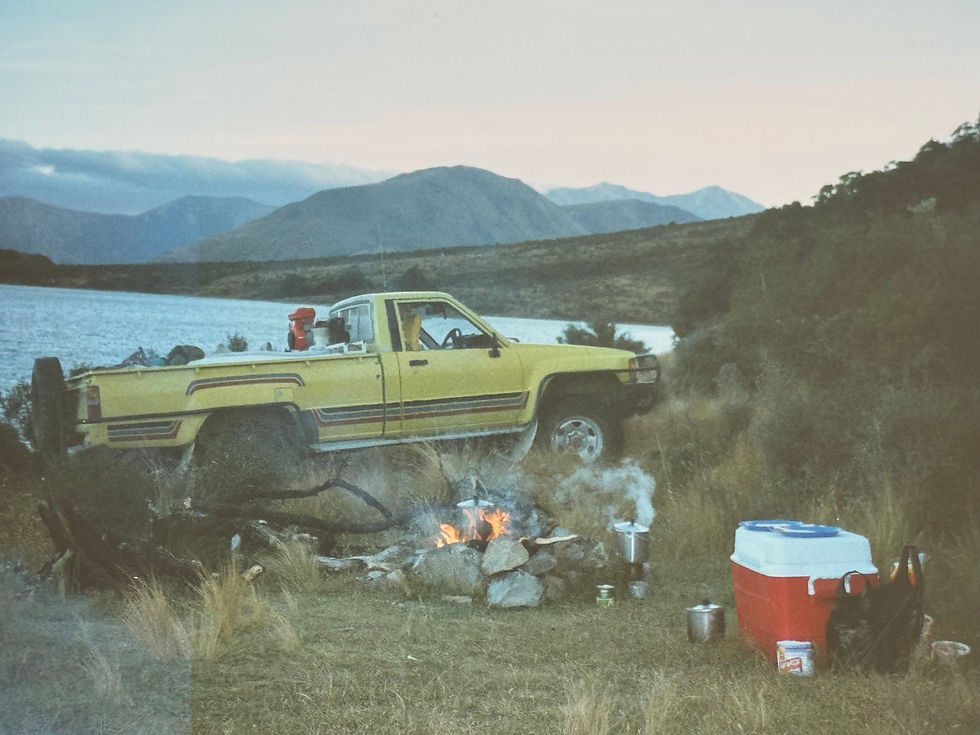
Sometimes even the Hilux cannot get there.
“Some of the most memorable times were doing animal pest monitoring in the Clarence Reserve. We were chasing a helicopter with a fuel tanker, flying people into locations. We put together survival bags with food, fuel, tents and sleeping bags plus spare fuel containers for the machine and left them at designated landing zones. If the helicopter didn’t come back for some reason, we knew we could walk there that day and be okay.”
Safety is a major focus.
“Safety’s one of the real key things,” says Godfrey. “We have an obligation to supply the best equipment we can to make sure our people can do the job safely. The first question we ask on a project is, can we do this safely? If yes, can we deliver it to specification? If both are yes, we go ahead.”
Moore adds, “On and off-road vehicle driving and accidents are our number one critical risk. When we put staff in new, safe vehicles, everyone sleeps a bit easier.”
Buying new is now standard policy.
“They come with good service plans and they’re not in the shop getting fixed because they’re brand new,” says Godfrey. “You can’t have a vehicle breaking down in the middle of nowhere. If you’ve got a truck under 200,000 kilometres and it’s serviced regularly, you don’t have problems. We buy the service plans and stick to them religiously. As a government contractor, sometimes clients ask for our service records, and when you sell a one-owner vehicle with full service history, there’s a waiting list.”
That service support extends to Rangiora Toyota, which keeps the company’s fleet running despite the demanding schedule.
“We can’t just bring a vehicle in on a Tuesday, it might be four and a half hours away up the back of Molesworth Station. The team at Rangiora Toyota make it work. They might get two or three vehicles at once late on a Friday and have them ready for Monday. They’ve never let us down.”

Compliance is another major focus.
“We’ve had to do GVM upgrades on our 79-series Land Cruisers,” says Godfrey. “We were putting spray reels and tanks on the back, so we increased the gross vehicle mass. They’re on COF now, which is a bit awkward, but they’re fit for purpose and fully compliant.”
Moore admits, “We realised we were on the limits on the hill in a 79-series Land Cruiser.” Godfrey adds, “There are companies getting away with things, and it’s all good until it’s not. You’ve got to get ahead of it. It’s like the Swiss cheese model, eventually all the holes line up and something gets through.”
That same principle applies to safety training, Godfrey says.
“We tell the crew, you’ve got a bucket of luck and a bucket of experience. People take a bit from the luck bucket to fill the experience bucket, and hopefully you’ve got sufficient experience before your luck runs out, but you don’t have to do it that way. We’ve got a lot of experience here, lean on it. Don’t learn the hard way, I don’t subscribe to learning the hard way.”

Godfrey currently drives the Hilux GR Sport and says it is one of his favourites. “It’s a pretty cool rig. It’s really comfortable, really fast and sticks to the track. I can get down to the Otago and back very relaxed in that vehicle. Each time Toyota brings out a Hilux, they make it slightly better than the last one.”
Asked about the biggest challenge in his business journey, Godfrey doesn’t hesitate. “Growing teams of people and changing culture,” he says. “Turning good things into amazing things. Taking people that have capabilities and making them into leaders. Jesse, for example, came as a fairly young, enthusiastic person who now runs a division of the business. Mark came to me as a guy who worked in the crews on the tools next to me, and now he’s running the company. It’s about stepping back and giving people the opportunity.”
After more than twenty Hiluxes, Godfrey says the formula still holds. “They’re just really versatile. If you can’t get there in a Hilux, you need a helicopter.”

Comments