
Rarotonga: Beyond the postcard
- Claire Inkson

- Aug 31
- 9 min read
A rain-soaked family escape to Rarotonga delivered spectacular snorkelling, slow days and a reminder of what it takes to live and grow food on a remote Pacific island.
The first thing I noticed when we stepped from the plane in Rarotonga was the air.
Warm, sweet and impossibly soft, it felt like a balm after the chilly, damp days Christchurch had been throwing at us.
Even the wait at the small airport, where customs became a drawn-out affair after the arrival of a full plane, had its own charm. An older local musician played island songs as the queue shuffled forward, setting the pace for the week ahead.
Once through, we were handed bottles of water, welcomed with lei’s of tropical flowers around our necks and ferried to The Edgewater Resort in a van.
I had imagined six days of doing very little beyond soaking up the sun beside the beach.
The weather had other ideas.
It rained like nothing this North Canterbury girl had ever seen. Not passing showers or polite bursts of drizzle, but warm, torrential bucketfuls that continued almost without pause for 48 hours.
Roads disappeared beneath puddles, beaches were washed out and a number of shops and restaurants closed because of flooding. We abandoned our plans to visit the Saturday market, something I was particularly disappointed to miss, and settled into the rhythm of waiting out the storm.

Fortunately, the resort restaurant remained open. Getting there required an umbrella each, although these frequently blew inside out before we made it through the door.
It was not cold, though, and there was something strangely luxurious about having nowhere else to be. We read books while the waves crashed outside and, after some determined technological wrangling, managed to get a sufficiently reliable VPN connection for my son to watch the FIFA World Cup.
I do not often get the opportunity to sit down and read without feeling I should be doing something else, so I did not entirely mind the rain.
When it finally lifted, the island seemed to reset itself almost overnight. The water covering the roads disappeared, the beaches began to re-emerge and everything looked fresh, intensely green and newly rinsed.
It was as though Rarotonga had taken a very long drink and simply carried on.

Island reality
The Edgewater suited us well in some important ways.
Travelling with my partner and three children aged 18, 15 and four meant space mattered, and our villa delivered that. There were two large bathrooms, a washing machine and enough room that we did not feel as though we were climbing over one another for six nights. Fans and heat pumps kept everything relatively comfortable.
The accommodation was comfortable rather than luxurious, and parts of it felt a little dated.
Our idea of a beachfront villa had also been slightly more literal. We had imagined stepping straight from the door onto the sand, while in reality the beach view was from a small balcony and partly screened by trees.
After several days of rain, the unheated pool was less tempting, while the coin-operated pool table in the games room came as a small surprise.
Hot water also required planning. The resort used solar water heating, which produced lukewarm water at best after two days without sunshine. Thankfully, there was a booster switch that could be turned on before showering.

One definite highlight was the resort spa, where we treated ourselves to a massage. It was blissful and easily one of the best parts of our stay.
None of the smaller disappointments ruined the holiday, but they were reminders to check exactly what terms such as “beachfront” and “resort facilities” mean before booking.
They also reflected the realities of life on a remote island, where energy, water, freight and food cannot be taken for granted in the way many of us are accustomed to in New Zealand.
Much of the food available in Rarotonga is imported, including from New Zealand, while local growers produce taro, root crops, coconuts, tropical fruit and vegetables for households, markets and businesses.
Agriculture here bears little resemblance to the large paddocks and extensive operations familiar to Rural Guardian readers. Food production is often small-scale and woven through homes and communities.
That makes it important not only economically, but also for food security. A delayed ship, disrupted flight, weather event or global price rise can quickly affect what is available and what it costs.
Tourism creates an obvious market for locally grown food, but consistently supplying hotels and restaurants on a small island is not straightforward. Growers must contend with limited land, tropical weather, labour constraints, freight costs and the need to protect the island from introduced pests and diseases.
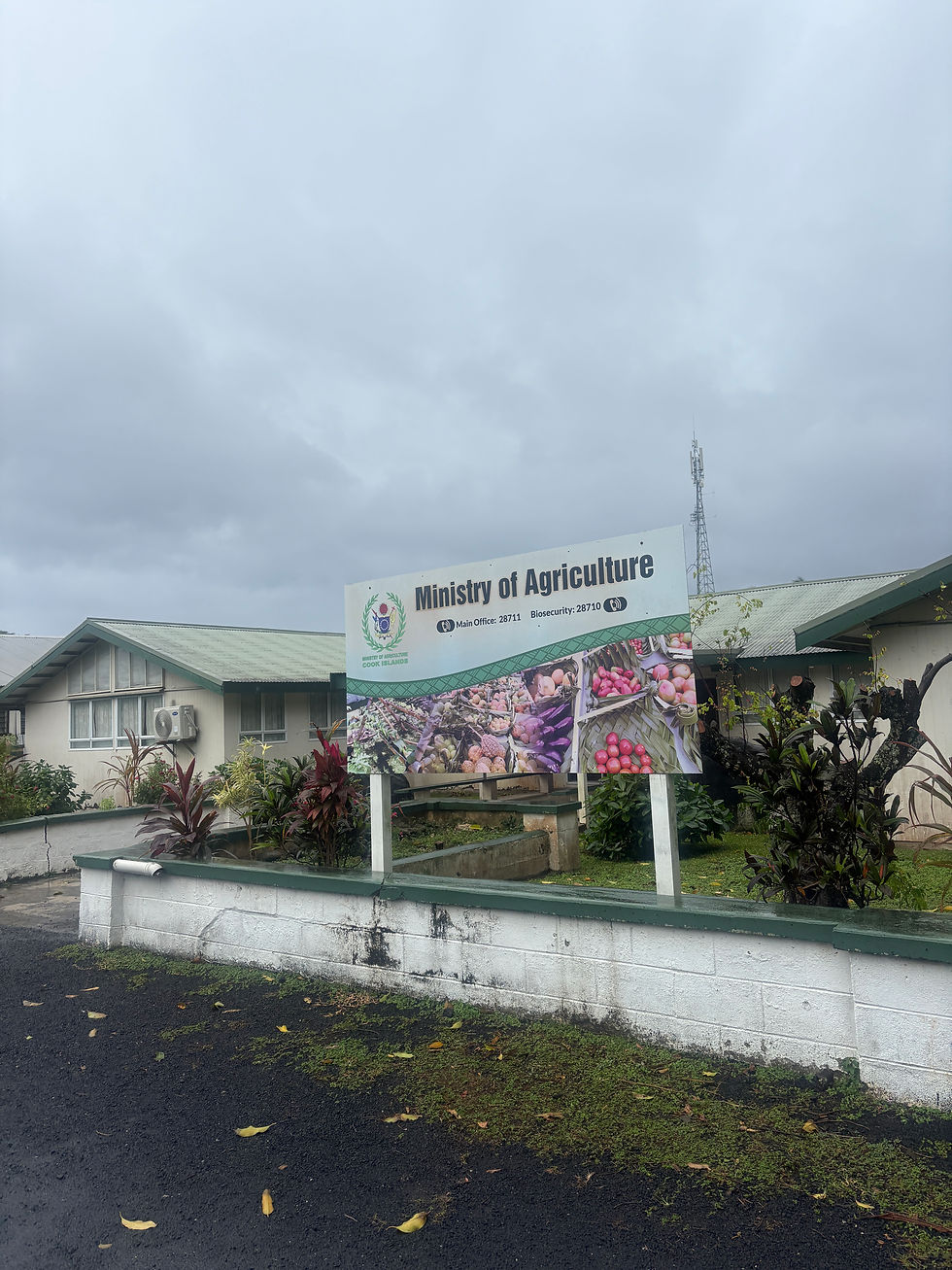
Biosecurity is taken seriously. Visitors must declare food, plants and other risk items brought into the Cook Islands. On an island, the arrival of a new pest or plant disease could have consequences far beyond one farm or backyard garden.
Chickens roam almost as freely as the dogs, scratching around roadsides, gardens and car parks as though the entire island belongs to them. Locals are encouraged not to feed either.
Despite being a dog lover, the dogs were a more complicated part of island life for me.
As someone who usually walks every day, I asked the receptionist whether it was safe to explore on foot. She advised me to carry a stick.
Most of the dogs appeared friendly, sleepy or completely uninterested in passers-by, but a few less comfortable encounters put me off walking around the island alone.

A holiday for doing less
There are countless ways to fill a Rarotonga itinerary, from mud buggies and lagoon cruises to paddleboarding, turtle tours and cultural experiences.
We did not take that approach.
We had arrived tired and fairly burned out, so the objective was less doing and more resting. Having a four-year-old also limited some activities and restaurant choices. A surprising number of dining venues are adults-only, which is understandable, but worth knowing before travelling as a family.
The children still had a blast.
The internet was patchy enough to make checking the final proofs of the newspaper I had completed before leaving rather frustrating. There was just enough bandwidth for football streaming, but otherwise it encouraged all of us to spend less time on our devices.
My 15-year-old loved snorkelling, while our four-year-old was perfectly content playing in the sand. We heard no complaints about boredom.
Much of Rarotonga is surrounded by a shallow lagoon, sheltered from the full force of the Pacific by the coral reef beyond it. This creates generally warm, calm water that is ideal for swimming and snorkelling, particularly for families, although currents, coral and marine life still demand respect.

Reef shoes are a must.
The water was so clear that snorkelling felt like swimming inside a tropical fish tank. Fish in an extraordinary range of colours moved through the coral below us, and my son was delighted to spot a pufferfish.
June is technically winter, but the water remained warm. Once the rain cleared, daytime temperatures settled comfortably in the mid-20s, with only slightly cooler evenings.
The western side of the island gave us some spectacular sunsets, with the sky shifting through gold, pink and deep orange over the lagoon.
Muri Beach, on the south-eastern side, is also well worth visiting. It is the Rarotonga of the postcards, with pale sand, clear lagoon water and small green islets sitting offshore.
It is also home to Sandals Restaurant at Pacific Resort. The food was excellent, but the service was what really stood out. It was easily the best we experienced during our stay.
Trader Jacks, an island institution overlooking the water in Avarua, was another highlight. The food was fresh and beautifully prepared, and the outlook was breathtaking. Charlie’s was a favourite for coffee.
Restaurant prices were, surprisingly, often a little cheaper than comparable dining in New Zealand.
The supermarkets were basic but stocked the necessities and were not as expensive as I had expected. They are worth using, particularly when travelling with children or staying somewhere with kitchen facilities.
The restaurant at The Edgewater kept us fed through the rain and did a remarkably good job considering the supply challenges faced by the island, although I would have loved to see more fresh, lighter options on the menu.

Getting around
Rarotonga is only about 32 kilometres around, and its bus system is one of the easiest and most entertaining ways to explore it.
One bus travels clockwise and another anticlockwise, circling the island’s main road and picking up passengers along the way.
The buses were often packed, making the open windows a godsend, but the drivers were cheerful, friendly and frequently hilarious.
At $5 per person for a single trip when we visited, the bus was considerably more appealing than the island’s expensive taxis.
One of the conveniences for New Zealand travellers is being able to use New Zealand currency. There is no need to calculate exchange rates every time you buy a coffee, meal or bus fare.
It is still advisable to carry cash. Many smaller businesses operate on a cash-only basis, and the local bus also requires cash payment. A supply of smaller notes makes getting around and buying from roadside stalls much easier.
Scooters are another popular option, although visitors need to understand the licensing rules before hiring one. An overseas licence generally covers only the same classes of vehicle the holder is entitled to drive at home. Anyone without a motorcycle class may need to obtain the appropriate Cook Islands visitor licence and complete testing.
Helmets are compulsory for riders and passengers.
Drinking water also requires a little adjustment. Tap water is not generally considered suitable for visitors to drink untreated. Our villa had a separate filtered tap, and filtered water stations are available around the island.
At restaurants, asking for water often meant purchasing a bottle rather than receiving a complimentary glass from the tap.
Sunday remains a day of church, family and rest for many locals, and the island slows considerably. Numerous shops, cafés and restaurants close, so it pays to buy breakfast and lunch supplies on Saturday or confirm somewhere will be open before setting out.
For weather updates, the Cook Islands Meteorological Service is well worth following. Its forecasts manage to be both informative and genuinely funny, a combination rarely achieved by a government weather service.

More than paradise
Rarotonga was not the flawless tropical escape I had imagined while packing in a cold Christchurch winter.
It was rainier, slightly rougher around the edges and more complicated than the postcard suggested.
But perhaps that made it more memorable.
We saw roads disappear beneath floodwater and become passable again within a day. We watched the lagoon change with the weather, snorkelled among tropical fish, travelled on overcrowded buses and sat together reading while rain hammered against the windows.
The experience also made me think about the hidden systems behind an island holiday.
Every restaurant meal, clean towel, litre of fuel and supermarket shelf depends on supply chains stretching across thousands of kilometres of ocean.
Local growers are producing food in limited space, under tropical weather conditions and with biosecurity risks that can threaten an entire island economy.
Tourism businesses still have a responsibility to provide what they advertise, of course. A beachfront villa should resemble the description, and visitors paying resort prices are entitled to expect thoughtful food and well-maintained rooms.
But it is also worth remembering where you are.
Rarotonga is not simply a resort surrounded by water.
It is a living island community where people grow food, attend church, raise families, run businesses and somehow keep thousands of visitors fed, transported and entertained despite the weather, distance and logistical challenges.
By the end of the week, we had stopped looking for the perfect holiday.
We were simply enjoying the one we had.
And once the sun finally arrived, Rarotonga was every bit as beautiful as we had hoped.
Before you go
· Carry cash: New Zealand currency is accepted, but the bus and many small businesses are cash-only. Smaller notes are useful.
· Plan for Sunday: Many shops, cafés and restaurants close while locals attend church or spend time with family. Buy supplies or book ahead.
· Drink filtered water: Use filtered taps or water stations rather than drinking untreated tap water.
· Pack reef shoes: They protect against sharp coral, rocks and marine hazards in the lagoon.
· Check scooter rules: A New Zealand car licence does not automatically allow you to ride a scooter. Check licence and testing requirements before hiring.
· Use the bus: Clockwise and anticlockwise services circle the island and are an affordable, entertaining alternative to taxis and fun even if you have hired a car.
· Follow the forecast: The Cook Islands Meteorological Service Facebook page provides regular, informative and often very funny updates.
· Book the spa: The Edgewater massage was one of the highlights of our stay, particularly after two days of tropical rain.
· Leave any leftover food or wine with a thank you note for the hotel cleaners – they will appreciate it.


Comments