
If these walls could talk: a new chapter for Rotherham’s old hospital

Updated: Oct 10, 2025
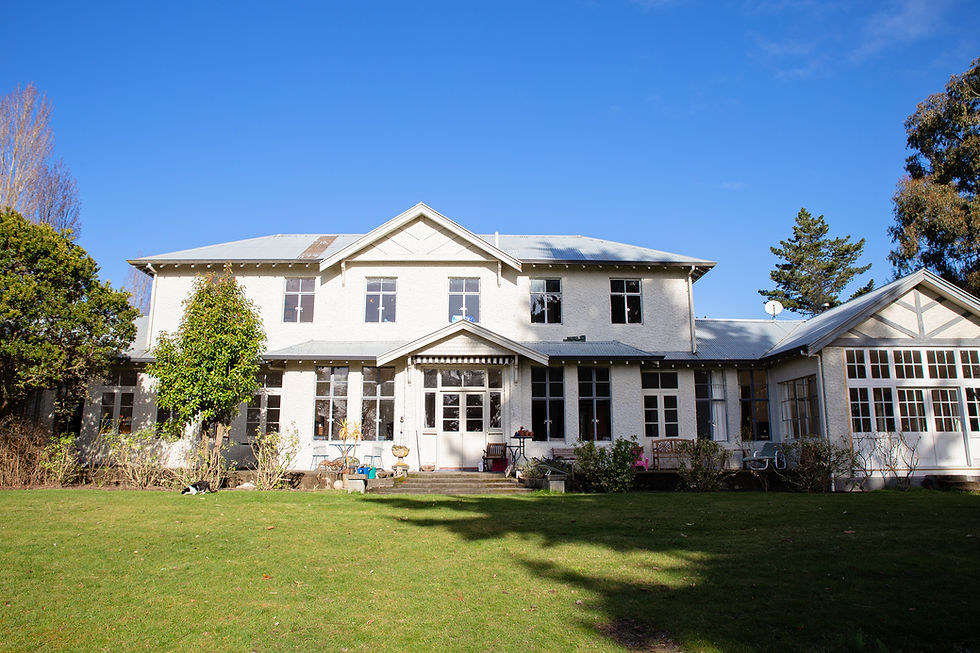
Nine months after turning the key on Rotherham’s landmark former Amuri Hospital, Sarah and Michael McGregor are still uncovering the building’s character - sometimes under coats of paint.
“The whole place was whitewashed, hiding a multitude of sins. We found purple skirting boards, a black room, orange paint over lino, but we also found original doors and historical lamps tucked away,” Sarah says.
The property, which the couple have renamed Amuri Manor, was on the market for five years, and a long-held dream of Sarah’s.
“We’d been looking for a place of peace, respite and retreat.”
With eight bedrooms, seven toilets and five showers - not to mention two hectares of grounds -the McGregor’s have their work cut out bringing the building back to life.
They are carefully restoring detail, room by room, with an eye on both hospitality and history, but it has its challenges.

Borer had well and truly made itself at home, and the boiler -which should have kept the large building toasty -has recently given up the ghost.
A new log burner has kept the winter chill at bay, but concrete walls have potentially thwarted Sarah’s wallpapering plans.
“When you have a 20-degree nor’west day, every single wall in this building weeps with condensation because the concrete’s colder than the air.”
Still, they are determined to press on and have already made extensive renovations, all in keeping with history.

“We’re going back to 1922,” Sarah says, “honouring the original plan.”
The building has long captured the curiosity of the Hurunui District.
The Amuri Hospital was decommissioned from service in the 1960s and became a private residence, its doors often firmly closed to the public.
The property harks back to a time when healthcare was much more accessible to rural communities, with the Waikari Hospital also just a half-hour drive away.
Rotherham’s hospital emerged from a post-WWI push to provide local maternity and medical care across North Canterbury’s rural districts.
Built in the early 1920s from robust concrete, it soon became a lifeline for the Amuri basin - handling maternity cases, farm accidents and convalescence - at a time when bridges, roads and ambulance services were sparse.
Through the 1930s and beyond, it dealt with everyday emergencies and celebrated everyday miracles.
In 1933, the celebrated aviator Aroha Clifford died here days after childbirth - one of many stories that tie the hospital to wider New Zealand history.
It nearly faced closure in the 1930s , with the North Canterbury Hospital Board deeming the facility too close to its wooden Waikari cousin, but locals fought to keep it open - and so it remained for another three decades.
Despite being a private residence under many different owners since the 1960s, elements of the building’s medical past remain.
An old fumigation room survives - once used to purify linen with sulphur - and vast windows in the nursery speak to a practice of settling babies in the sun to ward off jaundice.
A large skylight in what is now an office provided light for surgery and deliveries in the days before electricity.
The old morgue attached to an outside shed recalls more sombre times at the hospital. The couple intend to honour those people -including babies -whose outcomes were not happy ones, acknowledging how attitudes to infant loss have changed.
“We are going to be doing a Memorial Garden for the hospital, somewhere people can sit and remember.”
A building with such a history could easily invite a few ghost stories - but Sarah says any unwanted ghoulish guests have been keeping a low profile.
“They can stay if they want to - as long as they don’t cause any trouble,” she jokes.

A working vision: pay it forward
Income from Airbnb will underpin a koha/pay-it-forward arm: free or subsidised nights for carers who need respite, community leaders, creatives in residence - even weekend masterclasses where singers can “belt it out” without disturbing neighbours.
And the plan includes re-starting a community tradition:
“We will reinstate the hospital fete.”
While the property is, above all else, the McGregors’ home, they are open to engaging with the Amuri community, understand the connection locals feel to the place, and say they consider themselves custodians of the landmark.
“People have seen the grounds improve, we’re bringing some love back to the space,” Sarah says.
Community call-out: Help us tell Amuri Hospital’s story
Were you born here -or did a family member work, recover, or volunteer at the old Rotherham/Amuri Hospital? Do you have photos, admission cards, mementos, or stories about nurses, matrons, the wards, or the hospital fêtes?
Please share your memories by emailing claire.inkson@theguardian.co.nz.


Comments