
Westholm Dairies balances legacy and performance


For Luke and Nicole Kane, entering the Ballance Farm Environment Awards was as much about taking stock of their business as it was about recognition.
“Coming off the back of doing the Rabobank Executive Development Programme, we kind of thought we might have our ducks in a row better than we thought,” Luke Kane said.
“So, we thought, let’s give it a go.”
For Kane, who is also Otago provincial president of Federated Farmers, the process was a chance to step back and take a closer look at the business.
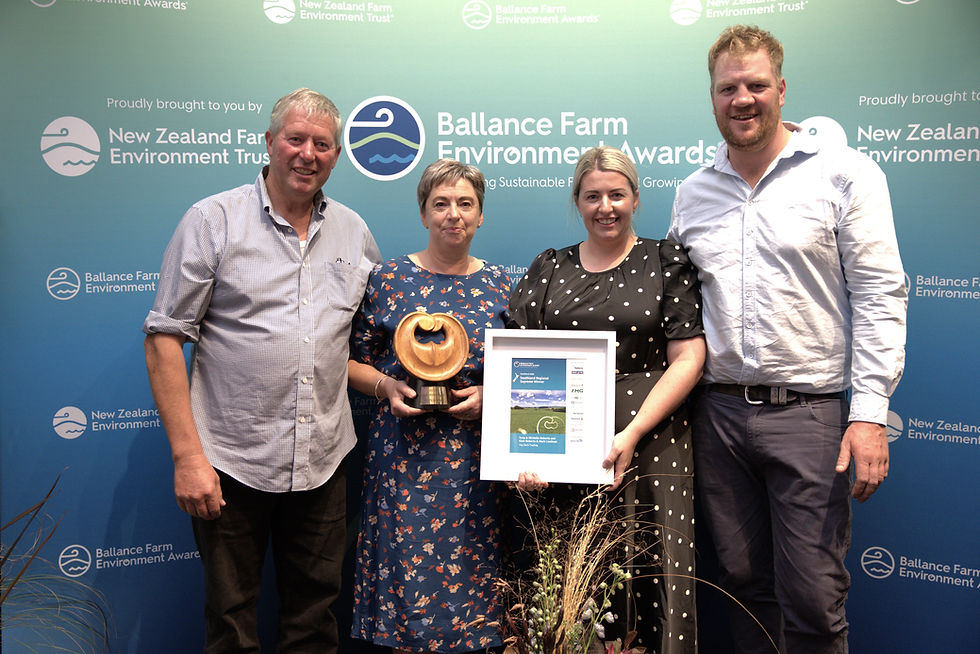
That decision saw the Westholm Dairies team, near Tapanui, named Otago Regional Supreme Winners, alongside picking up a suite of category awards recognising efficiency, sustainability, people and business management.
Westholm Dairies sits within the wider Kane family farming operation, which dates back to 1929, and that history plays a central role in how the business is run.
“Everyone looks at these operations and thinks this is a multi-million dollar business,” Kane said.
“But to keep it in the family, it’s a $1 valuation, because it’s not for sale.”
That mindset shapes how the farm is built and managed.
“You build it going this thing needs to last 50 plus years.”
A new calf shed is being designed to last two farming generations, while the dairy shed was built with the same long-term view.
The farm was originally sheep and beef, with a long association with Hereford cattle, and the move into dairy began around 2009.
“It was kind of clear the land class we have is very well suited to dairy,” Kane said.
“And it allowed that succession to happen, to provide that pathway for family.”
Today, the business milks around 700 cows, with approximately 250 hectares in the dairy platform and the balance used for support, young stock and beef finishing.
The transition into dairy came with a steep learning curve.
“We had no idea what we were getting ourselves into,” Kane said.
“We’ve made some very expensive mistakes along the way, but when it’s your own money you learn from those pretty quickly.”
He describes the business as still evolving.
“By no means finished. It’s a giant hobby.”
A key part of the system is its use of data and technology, from animal monitoring through to pasture and financial tracking, but Kane takes a practical approach.
“I’m not the first to buy the latest bit of tech. We watch others and see what works.”
The farm uses tools such as CowManager and Pasture.io, with advisers including vets, consultants and fertiliser representatives all working off the same information.
“It means everyone’s looking at the same data and talking at the same time.”
Artificial intelligence is also being used to support decision-making and administration.
“It’s like a calculator. You still need to know roughly what the answer should be.”
Environmental management is embedded into the way the farm operates. Feeding pads help reduce pressure on paddocks through winter, while around 9.5 kilometres of poplar shelterbelts have been planted across the dairy platform.
Poplars are propegated on-farm.
“Nearly every paddock now has shelter,” Kane said.
The approach focuses on practical outcomes, balancing animal welfare, pasture performance and long-term land care.
People are a strong focus for the business, reflected in the Bayleys People in Primary Sector Award .
The farm runs a small, stable team supported by a steady pipeline of young workers. Farm manager Hamish first started on the farm as a 14-year-old school student.
“Ever since him, we’ve always had a school kid coming through,” Kane said.
“Not every kid has been great, but the success rate’s probably 90 percent.”
Many stay connected to the farm, returning to help out or progressing further in the industry.
While the awards recognised the strength of the system, the process also highlighted areas for improvement.
“We knew we had a problem around recycling, like bale wrap disposal,” Kane said.
“That’s kicked us into gear and we’ve sorted that.”
It also prompted more formal documentation of systems already in place.
“A lot more stuff is written down now, not just in my head.”
Other Otago farmers were also recognised at this year’s awards, highlighting the depth and diversity of farming systems across the region.
Ben and Rebecca Trotter, of Black Peak Farming, Alpine Fresh and Red Bridge Berries in Luggate, picked up multiple category awards, including the Ballance Agri-Nutrients Soil Management Award, Hill Labs Agri-Science Award, Beef + Lamb New Zealand Livestock Farm Award, FMG Risk Management Award and the NZFET Innovation Award.
Morgan France, Ruby Herron and Kerry France, of Longview Farm at Moa Flat, received the Ministry for the Environment Biodiversity Award for their work enhancing on-farm biodiversity and environmental outcomes.
The East Otago Catchment Group was also showcased, recognised for its growth from a small group of farmers in 2019 into a coordinated network spanning multiple catchments. Through water quality monitoring, restoration projects and partnerships with iwi, schools and the wider community, the group is working toward improved freshwater health and stronger environmental outcomes across the region.
For Kane, the awards are less about validation and more about reflection.
“It just needs to operate and make money,” he said.
“And be there for the next generation.”

Comments